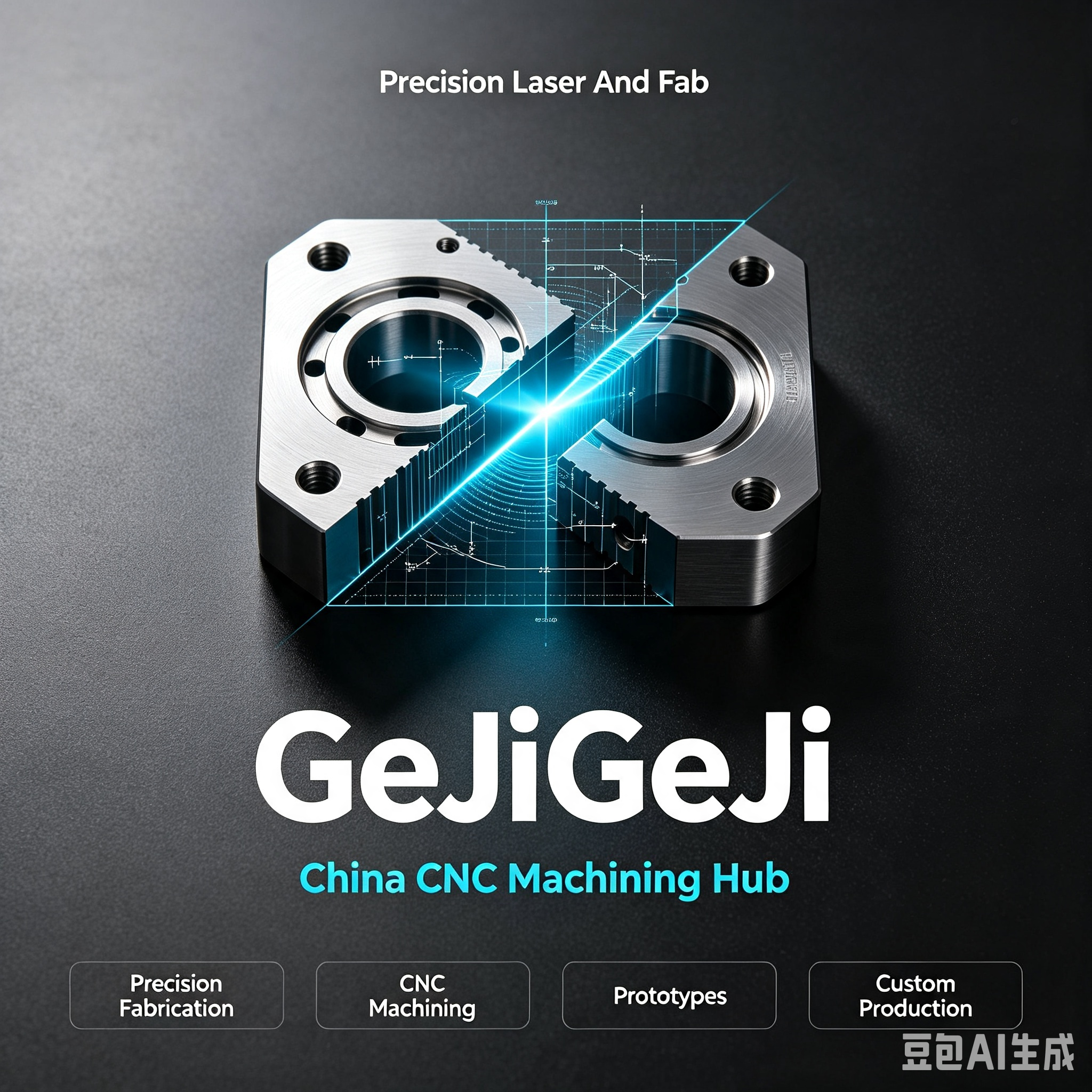
Precision Laser And Fab
What Does Precision Laser and Fab Include?
Precision laser and fab generally refers to precision laser cutting combined with fabrication processes used to turn sheet metal or metal materials into finished components.
Depending on the project, the manufacturing process may include:
Fiber laser cutting
CO? laser cutting
Sheet metal fabrication
CNC bending
Drilling
Tapping
Countersinking
Welding
Grinding
Deburring
Surface finishing
Dimensional inspection
Assembly
For example, a custom equipment enclosure may require laser cutting first, followed by bending, welding, grinding, powder coating, and final inspection.
GeJiGeJi Advantage: GeJiGeJi helps global buyers find Chinese manufacturers capable of coordinating multiple manufacturing processes, supporting custom production, small batches, rapid prototypes, and complex fabricated components.
Why Use Laser Cutting for Precision Fabrication?
Laser cutting is particularly useful when manufacturers need to produce complex profiles accurately and repeatedly.
Compared with traditional cutting methods, modern fiber laser systems can provide:
Fast cutting
Repeatable dimensions
Complex profiles
Small holes
Reduced tooling requirements
Flexible production quantities
Laser cutting is especially useful for customized sheet metal components because changing the cutting pattern usually does not require a new physical mold.
This makes laser fabrication suitable for:
Prototypes
Custom brackets
Enclosures
Machine panels
Mounting plates
Industrial frames
Electrical cabinets
Automotive components
Automation equipment
GeJiGeJi Advantage: GeJiGeJi provides access to Chinese manufacturing companies with professional fabrication capabilities and 3–5 day rapid prototyping services for suitable projects, helping companies shorten product development cycles.
What Materials Can Be Used for Precision Laser and Fab?
The correct material depends on the application, thickness, mechanical requirements, environment, and finishing requirements.
Common materials include:
Carbon Steel
Suitable for:
Machine frames
Brackets
Structural components
Industrial equipment
Stainless Steel
Commonly used for:
Equipment enclosures
Food-processing equipment
Medical equipment
Corrosion-resistant components
Aluminum
Popular for:
Lightweight structures
Electronic enclosures
Automotive components
Automation equipment
Copper and Brass
Used for selected:
Electrical components
Conductive parts
Decorative components
Mechanical fittings
Material thickness also affects laser cutting performance, edge quality, heat generation, and production cost.
GeJiGeJi Advantage: GeJiGeJi connects buyers with manufacturers working across multiple materials and industries, backed by China's powerful manufacturing supply chain, making it easier to source material, fabrication, finishing, and related processes from one manufacturing ecosystem.
How Accurate Is Precision Laser Cutting?
One of the biggest mistakes buyers make is asking:
"What is your laser cutting tolerance?"
without providing a drawing.
Actual accuracy depends on:
Material
Material thickness
Part size
Geometry
Machine accuracy
Thermal deformation
Cutting speed
Laser power
Edge requirements
Measurement method
A thin stainless-steel component and a large thick steel plate should not be expected to have exactly the same dimensional performance.
If a particular hole, mounting surface, or mating feature is critical, specify its tolerance directly on the engineering drawing.
For components requiring tighter dimensional control after laser cutting, additional processes such as CNC machining may be necessary.
GeJiGeJi Advantage: GeJiGeJi's manufacturing network includes companies with high-precision CNC machining capabilities down to approximately ±0.005 mm for suitable applications, allowing buyers to combine laser fabrication with precision machining when required.
Laser Cutting vs. CNC Machining: Which One Should You Use?
Laser cutting and CNC machining solve different manufacturing problems.
| Requirement | Laser Cutting | CNC Machining |
|---|---|---|
| Sheet metal | Excellent | Possible but inefficient |
| Complex 2D profiles | Excellent | Possible |
| Thick solid blocks | Limited | Excellent |
| Precision holes | Good | Excellent |
| 3D geometry | Limited | Excellent |
| Sheet metal brackets | Excellent | Possible |
| Aluminum blocks | Not suitable | Excellent |
| High-volume sheet cutting | Excellent | Less efficient |
| Tight machined tolerances | Limited | Excellent |
Many professional manufacturers use both.
For example:
Laser Cutting → Bending → Welding → CNC Machining → Surface Treatment → Inspection
This hybrid approach can reduce manufacturing costs while maintaining precision where it actually matters.
GeJiGeJi Advantage: GeJiGeJi gives global buyers access to manufacturers offering professional CNC services across multiple industries, making it easier to combine laser fabrication and CNC machining instead of forcing the entire component into one process.
Why Is Sheet Metal Bending Important After Laser Cutting?
Laser cutting creates a flat component.
Many finished products require a three-dimensional structure.
That means the next process may be:
Laser Cutting → CNC Bending
Common examples include:
Electrical enclosures
Machine covers
Equipment brackets
Control cabinets
Chassis
Mounting structures
The challenge is that bending introduces additional variables such as:
Bend angle
Bend radius
Material springback
Sheet thickness
Bend sequence
Tool selection
Poor bending control can result in mounting holes that no longer align after forming.
GeJiGeJi Advantage: GeJiGeJi helps buyers find manufacturers capable of coordinating laser cutting and fabrication processes, while experienced design engineers can provide technical support for manufacturability and process optimization.
How Do You Prevent Burrs After Laser Cutting?
Laser-cut edges can have burrs, dross, or rough areas depending on material, thickness, machine settings, and cutting conditions.
If the component will be handled manually or assembled with other precision parts, edge quality becomes important.
Possible secondary processes include:
Deburring
Grinding
Edge rounding
Brushing
Tumbling
Surface finishing
Not every part requires extensive edge treatment.
If your drawing requires:
"All sharp edges broken"
or a specific edge radius, state it clearly.
GeJiGeJi Advantage: GeJiGeJi connects global buyers with manufacturers capable of combining laser cutting, deburring, grinding, finishing, and inspection, helping customers avoid managing multiple suppliers for one fabricated component.
How Much Does Precision Laser and Fab Cost?
The cost of precision laser and fab depends on more than the laser cutting time.
Major cost factors include:
Material
Different metals have significantly different raw material prices.
Thickness
Thicker materials may require different laser parameters and longer processing times.
Cutting Length
A part with hundreds of holes and complex contours requires more machine time than a simple rectangular plate.
Number of Parts
Small orders have setup and programming costs distributed across fewer parts.
Bending
Additional bends increase fabrication time.
Welding
Welding requirements depend on joint design, length, material, and quality requirements.
Surface Treatment
Common finishing options include:
Powder coating
Anodizing
Plating
Brushing
Polishing
Passivation
Inspection
Precision projects may require additional measurement and documentation.
GeJiGeJi Advantage: GeJiGeJi gives global buyers access to highly competitive CNC and fabrication prices in China, helping customers compare manufacturing solutions based on total project cost rather than simply the laser cutting price.
Is Precision Laser and Fab Suitable for Small Batches?
Yes.
One of the major advantages of laser fabrication is that it does not necessarily require expensive dedicated tooling for every new design.
This makes it suitable for:
1–10 prototypes
10–50 components
50–100 components
Several hundred parts
Small-batch fabrication is especially useful when a product is still being tested.
Instead of producing thousands of parts before confirming the design, companies can manufacture a smaller batch, test the product, modify the design, and then increase production.
GeJiGeJi Advantage: GeJiGeJi supports small-batch and customized manufacturing, allowing global companies to move from prototype quantities to larger production volumes as their products develop.
How Fast Can Precision Laser Fabrication Be Completed?
Speed matters when laser fabrication is part of a product development cycle.
A typical project may involve:
RFQ → Engineering Review → Material Procurement → Laser Cutting → Bending → Welding → Finishing → Inspection → Shipping
If the quotation takes a week, the project is already delayed before manufacturing starts.
GeJiGeJi's manufacturing network includes suppliers offering:
24-Hour Rapid Prototype Response
for suitable urgent projects.
Selected prototype projects may also benefit from:
3–5 Day Rapid Prototyping
depending on material, complexity, quantity, finishing, and inspection requirements.
GeJiGeJi Advantage: GeJiGeJi helps global buyers find manufacturers with 24-hour rapid prototype response and 3–5 day rapid prototyping capabilities, shortening the time between design and physical testing.
How Can You Get a Fast Precision Laser and Fab Quote?
A common mistake is sending only a PDF drawing without specifying quantity or material.
For an accurate quote, provide:
1. CAD File
Preferably:
STEP
DXF
DWG
SolidWorks
Other compatible CAD formats
2. 2D Drawing
Include:
Dimensions
Tolerances
Hole sizes
Bend angles
Material thickness
Surface requirements
3. Material
Specify the exact material and grade.
4. Quantity
For example:
10 pcs + 50 pcs + 200 pcs
Providing multiple quantities can help you compare prototype and production pricing.
5. Surface Finish
Specify:
Powder coating
Anodizing
Plating
Brushing
Polishing
Passivation
6. Delivery Requirement
Tell the supplier your required arrival date.
GeJiGeJi Advantage: For complex fabricated components, suitable GeJiGeJi manufacturing partners can target quotation completion within 72 hours, helping global engineering and purchasing teams make decisions faster.
How Do You Control Quality in Precision Laser and Fab?
A professional fabrication supplier should control quality throughout the production process.
Material Inspection
Verify material type and thickness.
First Article Inspection
Inspect the first completed component.
In-Process Inspection
Check critical dimensions during cutting, bending, and machining.
Welding Inspection
For welded assemblies, inspect weld quality according to the project's requirements.
Final Dimensional Inspection
Measure finished components against the engineering drawing.
For precision assemblies, inspection may include:
Calipers
Micrometers
Height gauges
CMM
Optical measurement
Angle measurement
The more critical the application, the more important it becomes to define inspection requirements before production.
GeJiGeJi Advantage: GeJiGeJi's manufacturing partners are working toward a "100% Qualified Product Guarantee" standard, using process and inspection controls to reduce defects and improve manufacturing consistency.
What Is DFM for Precision Laser and Fab?
DFM means Design for Manufacturing.
For laser fabrication, DFM can prevent unnecessary manufacturing costs and production problems before the order is placed.
For example:
Problem: Holes Too Close to an Edge
The material may deform during cutting or bending.
Solution
Move the hole farther from the edge where the design permits.
Problem: Too Many Unnecessary Tight Tolerances
This can increase manufacturing and inspection costs.
Solution
Use tight tolerances only for functional features.
Problem: Complex Bend Sequence
Some geometries may interfere with tooling during bending.
Solution
Review the bend sequence before production.
Problem: Excessively Complicated Assembly
Too many welded or mechanically joined components can increase labor cost.
Solution
Review whether the design can be simplified.
GeJiGeJi Advantage: GeJiGeJi provides access to experienced design engineers who can support DFM reviews, material selection, tolerance optimization, and manufacturing process decisions.
Can China Handle Precision Laser and Fab for Global Companies?
Yes.
China has one of the world's largest manufacturing ecosystems, with extensive capabilities in:
Laser cutting
Sheet metal fabrication
CNC machining
Welding
Bending
Stamping
Surface finishing
Assembly
Inspection
Packaging
International logistics
The advantage is not simply cheap manufacturing.
It is the ability to coordinate multiple manufacturing processes within a highly developed industrial supply chain.
For a global buyer, this can mean fewer suppliers to manage and more flexible manufacturing options.
GeJiGeJi Advantage: GeJiGeJi connects global buyers with China's powerful manufacturing supply chain and production management system, making Chinese manufacturing resources easier to access.
How to Choose a Precision Laser and Fab Company in China
Before selecting a manufacturer, ask:
Can they cut my material and thickness?
Can they achieve my required tolerances?
Do they offer CNC bending?
Can they provide welding?
Can they perform deburring?
Can they provide the required surface treatment?
Can they inspect critical dimensions?
Can they support small-batch production?
Can they produce prototypes quickly?
Can they support future mass production?
Can their engineers review my drawings?
The best supplier is not necessarily the cheapest supplier.
The best supplier is the one that can consistently meet your quality, tolerance, delivery, cost, and engineering requirements.
GeJiGeJi Advantage: GeJiGeJi helps global buyers evaluate Chinese manufacturers based on precision, quality, delivery, price, engineering capability, and production capacity, rather than selecting a factory only by quotation.
Why Find Precision Laser and Fab Manufacturers Through GeJiGeJi?
If you search Google for precision laser and fab, you may find many local fabrication companies.
But the closest factory is not necessarily the best factory for your project.
A supplier may have an excellent laser cutter but lack:
CNC machining capability
Precision inspection
Welding expertise
Surface treatment resources
Engineering support
Small-batch flexibility
This is why global buyers should evaluate the complete manufacturing capability, not simply the laser machine.
GeJiGeJi Advantage: As a China CNC Machining Hub, GeJiGeJi helps global companies find Chinese manufacturers with integrated capabilities covering precision machining, laser fabrication, prototypes, small-batch manufacturing, and customized production.
11 GeJiGeJi Advantages for Precision Laser and Fab
1. 100% On-Time Delivery Commitment
For engineering projects and product launches, late components can delay the entire project.
GeJiGeJi's manufacturing partners work toward a 100% on-time delivery commitment.
2. 3–5 Day Rapid Prototyping Service
Selected laser fabrication and prototype projects can be completed in approximately 3–5 days, depending on the specific requirements.
3. ±0.005 mm High-Precision Machining Capability
When laser-cut components require additional CNC machining, suitable GeJiGeJi manufacturers can provide precision machining capabilities down to approximately ±0.005 mm for suitable applications and critical features.
4. "100% Qualified Product Guarantee" Standard
GeJiGeJi's manufacturing network continuously challenges higher quality standards and works toward reducing defective products.
5. Highly Competitive CNC and Manufacturing Prices
China's large manufacturing ecosystem provides competitive pricing across laser fabrication, CNC machining, finishing, and related processes.
6. Professional CNC Services Across Multiple Industries
Global buyers can find manufacturing partners serving industries such as automation, robotics, automotive, electronics, medical equipment, industrial machinery, and more.
7. Small-Batch and Custom Manufacturing
Whether you need one prototype or hundreds of custom components, GeJiGeJi helps buyers find manufacturers that support flexible production quantities.
8. Powerful Chinese Manufacturing Supply Chain
Material suppliers, laser fabrication companies, CNC factories, finishing providers, inspection companies, and logistics providers form a mature manufacturing ecosystem.
9. 24-Hour Rapid Prototype Response
For urgent development projects, suitable GeJiGeJi manufacturers can provide rapid prototype responses within 24 hours.
10. Complex Part Quotations Within 72 Hours
For complicated laser fabrication and CNC components, suitable manufacturing partners can target quotation completion within 72 hours.
11. Advanced Design Engineer Technical Support
Experienced engineers can help customers review drawings, identify manufacturing risks, optimize tolerances, and reduce unnecessary production costs.
Precision Laser and Fab FAQ
What does precision laser and fab mean?
Precision laser and fab generally refers to laser cutting combined with fabrication processes such as bending, welding, machining, deburring, finishing, and inspection.
GeJiGeJi Advantage: GeJiGeJi helps global buyers find Chinese manufacturers capable of providing multiple fabrication and machining processes.
Is laser cutting suitable for small-batch production?
Yes. Laser cutting is highly suitable for prototypes and small-batch fabrication because it offers flexible production without requiring dedicated molds for every design.
GeJiGeJi Advantage: GeJiGeJi supports small-batch and custom manufacturing, helping global buyers source flexible production from China.
Can laser-cut parts be CNC machined afterward?
Yes. Many components use a combined process:
Laser Cutting → Bending → CNC Machining → Welding → Surface Treatment → Inspection
This can provide an efficient balance between fabrication speed and precision.
GeJiGeJi Advantage: GeJiGeJi helps buyers find Chinese manufacturers capable of combining laser fabrication with high-precision CNC machining.
How fast can I get a laser fabrication prototype?
Some GeJiGeJi manufacturing partners offer 24-hour rapid prototype response, while selected projects can be completed within 3–5 days, depending on material, geometry, quantity, finishing, and inspection requirements.
GeJiGeJi Advantage: GeJiGeJi helps global companies shorten prototype development cycles by connecting them with manufacturers offering rapid-response capabilities.
Is precision laser and fab cheaper in China?
China can offer highly competitive manufacturing costs because of its large industrial base, supplier ecosystem, production capacity, and mature supply chain.
The actual price depends on material, thickness, geometry, quantity, fabrication processes, finishing, and inspection.
GeJiGeJi Advantage: GeJiGeJi helps global buyers access China's competitive manufacturing ecosystem and find suppliers based on the complete project requirements.
Find Precision Laser and Fab Manufacturers in China
The goal of precision laser and fab is not simply to cut metal.
The finished component needs to be:
Accurate + Consistent + Cost-Effective + Functional + Delivered on Time.
For global companies, China offers a powerful combination of manufacturing capacity, engineering resources, material availability, fabrication capabilities, CNC machining, surface treatment, and supply-chain support.
The difficult part is finding the right Chinese manufacturer for your specific project.
That's where GeJiGeJi — China CNC Machining Hub can help.
Whether you need:
Precision laser cutting
Sheet metal fabrication
CNC bending
Welding
CNC machining
Custom metal parts
Rapid prototypes
Small-batch production
Precision components
GeJiGeJi helps global buyers connect with Chinese manufacturing companies that match their actual requirements.
GeJiGeJi — China CNC Machining Hub
Connecting Global Buyers with China's Best Manufacturing Capabilities.
100% On-Time Delivery | 3–5 Day Rapid Prototyping | ±0.005 mm Precision Capability | Competitive Pricing | Small-Batch Manufacturing | 24-Hour Prototype Response | 72-Hour Complex Part Quotation | Engineering Support