CNC Prototype Machining in China | Rapid CNC Prototyping
CNC Prototype Machining: How to Get High-Precision Prototypes Faster and at Lower Cost
When a new product is still in the development stage, the biggest manufacturing challenge is usually not finding a CNC machine.
The real challenge is finding a CNC prototype machining partner that can turn your CAD file into an accurate, functional prototype quickly—without creating problems when you move to production.
A good CNC prototype supplier should be able to answer five critical questions:
How quickly can I receive my prototype?
Can the prototype meet my required tolerances?
Can the manufacturer work with my material and surface finish?
How much will the prototype cost?
Can the same supplier support low-volume and mass production later?
This is where GeJiGeJi — China CNC Machining Hub can help global companies connect with capable CNC prototype manufacturers in China.
What Is CNC Prototype Machining?
CNC prototype machining is the process of manufacturing functional prototypes directly from engineering drawings or 3D CAD files using CNC machining equipment.
Unlike 3D printing, CNC prototype machining removes material from a solid block or bar to create the final component.
This makes CNC machining particularly useful when a prototype needs to represent the final production part in terms of:
Mechanical strength
Dimensional accuracy
Surface finish
Material properties
Functional performance
Assembly compatibility
CNC prototypes are commonly used for:
Product development
Engineering validation
Functional testing
Assembly testing
Design verification
Customer demonstrations
Pre-production testing
GeJiGeJi Advantage: GeJiGeJi helps global companies find Chinese CNC manufacturers that can support both rapid prototypes and production manufacturing, reducing the need to change suppliers after product validation.
How Fast Can CNC Prototype Machining Be?
For product development teams, prototype lead time can directly affect the product launch schedule.
A traditional prototype process can involve:
CAD Design → RFQ → Supplier Selection → Programming → Machining → Inspection → Shipping
If the quotation takes several days and production takes several weeks, even a simple prototype can significantly delay development.
GeJiGeJi's manufacturing network includes suppliers offering:
24-Hour Rapid Prototype Response
For urgent projects, some manufacturers can respond to prototype requirements within 24 hours.
3–5 Day Rapid Prototyping
Depending on part complexity, material, quantity, finishing, and inspection requirements, some CNC manufacturers can complete prototypes within 3–5 days.
This can significantly shorten the engineering validation cycle.
GeJiGeJi Advantage: GeJiGeJi helps global buyers discover CNC prototype manufacturers with rapid-response capabilities instead of spending days searching for suppliers individually.
What Information Do You Need to Get a CNC Prototype Quote?
One of the biggest causes of slow quotations is incomplete information.
If you want a fast and accurate CNC prototype machining quotation, provide:
1. 3D CAD File
Recommended formats include:
STEP
STP
IGES
X_T
SolidWorks files
2. 2D Engineering Drawing
Include critical:
Dimensions
Tolerances
Threads
Hole specifications
Surface roughness
Geometric tolerances
3. Material
For example:
Aluminum 6061
Aluminum 7075
Stainless Steel 304
Stainless Steel 316
Brass
Copper
Titanium
POM
PEEK
Nylon
4. Quantity
Clearly specify whether you need:
1 prototype
5 prototypes
10 prototypes
50 prototypes
Low-volume production
5. Surface Finish
Specify requirements such as:
Anodizing
Hard anodizing
Powder coating
Plating
Passivation
Electropolishing
Sandblasting
Brushing
6. Required Delivery Date
Tell the manufacturer when you actually need the parts.
GeJiGeJi Advantage: GeJiGeJi encourages buyers to submit complete technical information so qualified manufacturers can provide faster and more accurate quotations. For complex CNC parts, some GeJiGeJi manufacturing partners can complete quotations within 72 hours.
How Much Does CNC Prototype Machining Cost?
There is no universal CNC prototype price.
The cost depends on several variables.
Material Cost
Aluminum prototypes are generally different in cost from stainless steel, titanium, or engineering plastics.
Machining Time
A simple bracket may take minutes to machine, while a complex 5-axis component may require hours.
Part Complexity
Complex geometries require more programming, tooling, setups, and inspection.
Number of Setups
A part requiring multiple orientations may cost more than a component that can be machined in one or two setups.
Tolerance
A prototype requiring ±0.005 mm on critical dimensions may require additional process control and inspection.
Surface Treatment
Anodizing, plating, polishing, coating, and other processes add cost and lead time.
Quantity
The unit price can decrease when multiple identical prototypes are manufactured because programming and setup costs are distributed across more parts.
GeJiGeJi Advantage: GeJiGeJi gives global buyers access to China's highly competitive CNC manufacturing ecosystem, helping them compare manufacturing solutions rather than relying on a single supplier's prototype price.
Can CNC Prototype Machining Achieve ±0.005 mm Tolerance?
For certain components and specific dimensions, advanced CNC machining processes can achieve very tight tolerances.
GeJiGeJi manufacturing partners include precision machining companies with capabilities down to approximately:
±0.005 mm
However, buyers should understand an important point:
±0.005 mm is not automatically achievable on every feature of every CNC prototype.
Actual achievable tolerance depends on:
Part size
Material
Geometry
Machine condition
Tooling
Thermal stability
Machining strategy
Number of setups
Measurement equipment
Therefore, instead of asking:
"Can you achieve ±0.005 mm?"
A better question is:
"Can you achieve ±0.005 mm on this specific critical feature shown on my drawing?"
The supplier should evaluate the actual part before confirming the tolerance.
GeJiGeJi Advantage: GeJiGeJi helps customers find precision CNC manufacturers with the equipment, engineering experience, and inspection capabilities needed for demanding prototype requirements.
What Materials Can Be Used for CNC Prototypes?
One of the major advantages of CNC prototype machining is the wide range of materials available.
Aluminum CNC Prototypes
Popular for:
Consumer electronics
Automation equipment
Robotics
Automotive components
Industrial products
Common choices include 6061 and 7075 aluminum.
Stainless Steel Prototypes
Suitable for:
Industrial equipment
Medical equipment
Food processing machinery
Corrosion-resistant components
304 and 316 stainless steel are commonly used.
Brass and Copper
Useful for:
Electrical components
Connectors
Heat-transfer components
Mechanical fittings
Titanium
Used when high strength-to-weight ratio and corrosion resistance are important.
Engineering Plastics
Common materials include:
POM
PEEK
Nylon
PTFE
PC
ABS
The best material depends on the prototype's actual application.
GeJiGeJi Advantage: GeJiGeJi connects buyers with CNC manufacturers experienced in machining metals and engineering plastics across multiple industries.
CNC Prototype Machining vs. 3D Printing: Which Should You Choose?
The correct process depends on what you need to test.
| Requirement | CNC Prototype | 3D Printing |
|---|---|---|
| Functional mechanical testing | Excellent | Depends on material |
| Metal prototype | Excellent | Limited by process |
| High dimensional accuracy | Excellent | Process dependent |
| Production-like material | Excellent | Depends on technology |
| Complex internal geometry | Limited | Excellent |
| Rapid visual prototype | Good | Excellent |
| Surface finish | Excellent | Process dependent |
| Low-volume production | Excellent | Good |
If your prototype needs to behave like the final production component, CNC prototype machining is often the better choice, particularly when the final product will also be CNC machined.
GeJiGeJi Advantage: GeJiGeJi helps customers identify CNC manufacturers based on the actual purpose of the prototype—not simply the lowest manufacturing price.
When Should You Use CNC Prototype Machining?
CNC prototypes are particularly valuable when you need to verify:
Mechanical Fit
Does the component fit correctly with other parts?
Functional Performance
Does the mechanism actually work?
Dimensional Accuracy
Are critical dimensions within specification?
Assembly
Can the complete product be assembled without interference?
Material Performance
Does the selected material perform as expected?
Surface Finish
Does the prototype meet the required appearance and functional surface requirements?
This makes CNC prototype machining especially useful before committing to expensive tooling or mass production.
GeJiGeJi Advantage: GeJiGeJi helps companies move from digital designs to physical prototypes quickly, allowing engineering teams to identify problems before full-scale production.
What Happens After the CNC Prototype Is Approved?
This is an important question that many buyers overlook.
A prototype supplier should ideally be capable of supporting the next stages:
Prototype → Design Validation → Low-Volume Production → Mass Production
Changing suppliers after prototype approval can create new problems.
The second supplier may have different:
Machining processes
Tolerance capabilities
Material sources
Quality standards
Production methods
This can make production consistency more difficult.
GeJiGeJi manufacturing partners can support different production stages, including:
Rapid prototypes
Small-batch manufacturing
Low-volume production
Custom production
Larger production runs
GeJiGeJi Advantage: GeJiGeJi helps global companies find manufacturing partners capable of growing with their projects instead of treating prototyping and production as completely separate processes.
CNC Prototype Machining for Low-Volume Production
Not every product needs mass production.
Many companies need:
10 pieces
25 pieces
50 pieces
100 pieces
500 pieces
These orders are common for:
Industrial equipment
Robotics
Automation
R&D projects
Replacement components
Specialized machinery
Startups
CNC machining is particularly suitable for these situations because it does not require expensive injection molds or dedicated production tooling.
GeJiGeJi Advantage: GeJiGeJi supports global buyers looking for both CNC prototypes and low-volume custom manufacturing in China.
How Does China Make CNC Prototype Machining Competitive?
China's advantage is not simply low labor costs.
The stronger advantage is the combination of:
Manufacturing Scale + Supply Chain Depth + Engineering Talent + CNC Capacity + Material Availability + Processing Services
A single CNC prototype may require:
Material → CNC Machining → Heat Treatment → Surface Finishing → Inspection → Packaging → International Shipping
China has mature supplier networks supporting these processes.
This allows manufacturers to coordinate multiple production stages efficiently.
The result can be:
Competitive prototype pricing
Faster production
Flexible order quantities
Extensive material choices
Multiple finishing options
Easier transition to production
GeJiGeJi Advantage: GeJiGeJi gives global customers access to one of the world's most powerful manufacturing supply chains and production management ecosystems.
How Is CNC Prototype Quality Controlled?
A professional CNC prototype manufacturer should not wait until the end of production to discover problems.
A strong quality-control process may include:
Incoming Material Inspection
Verify the material specification.
First Article Inspection
Check the first completed component.
In-Process Inspection
Monitor critical dimensions during machining.
Final Inspection
Confirm the finished component against the engineering drawing.
Precision Measurement
Depending on the part, manufacturers may use:
CMM
Optical measurement systems
Micrometers
Calipers
Height gauges
Surface roughness testers
For demanding parts, inspection documentation can also be provided.
GeJiGeJi's manufacturing partners continuously work toward higher quality standards, with some manufacturers challenging a "100% Qualified Product Guarantee" standard through strict production and inspection processes.
GeJiGeJi Advantage: GeJiGeJi prioritizes manufacturers that treat quality control as part of the production process rather than simply inspecting parts before shipment.
How Important Is Delivery Reliability for CNC Prototypes?
A prototype that arrives after the engineering test deadline has limited value.
For example:
Prototype delayed by 2 weeks → Testing delayed → Design changes delayed → Production delayed → Product launch delayed
This is why prototype delivery should be evaluated alongside price and machining capability.
GeJiGeJi's manufacturing network includes suppliers committed to:
100% On-Time Delivery
through production planning, capacity management, quality control, and delivery coordination.
GeJiGeJi Advantage: GeJiGeJi helps global buyers find manufacturing partners that understand the importance of delivery schedules, not simply machining capability.
Which Industries Use CNC Prototype Machining?
CNC prototype machining is used across many industries.
Robotics
Prototype:
Robot components
Joint housings
Precision brackets
Structural components
Industrial Automation
Prototype:
Machine components
Fixtures
Automation modules
Custom brackets
Automotive
Prototype:
Functional components
Mechanical housings
Custom brackets
Testing components
Aerospace
Prototype:
Lightweight structures
Precision components
Complex mechanical parts
Medical Equipment
Prototype:
Device housings
Precision mechanical components
Functional assemblies
Electronics
Prototype:
Housings
Heat sinks
Structural components
Mechanical interfaces
GeJiGeJi Advantage: GeJiGeJi provides access to professional CNC machining services across multiple industries, helping companies find manufacturers with relevant application experience.
How to Choose the Right CNC Prototype Machining Company in China
Before choosing a supplier, ask these questions:
1. Can they machine my material?
2. Can they achieve my critical tolerances?
3. What inspection equipment do they use?
4. How quickly can they provide a prototype?
5. Can they provide surface finishing?
6. Can they support low-volume production?
7. Can they support mass production later?
8. Can their engineers review my design?
9. Can they provide a realistic delivery date?
10. How quickly can they quote complex parts?
A supplier that can answer these questions clearly is usually more valuable than a supplier that simply offers the lowest price.
GeJiGeJi Advantage: GeJiGeJi helps global buyers focus on manufacturing capability, engineering support, quality, speed, and delivery instead of selecting a supplier based solely on price.
Why Choose GeJiGeJi for CNC Prototype Machining in China?
Finding a CNC prototype supplier in China is easy.
Finding the right CNC prototype supplier is much harder.
China has thousands of machining companies, but their capabilities are different.
One may be excellent at aluminum milling.
Another may specialize in precision turning.
Another may have advanced 5-axis equipment.
Another may specialize in rapid prototypes.
Another may be better suited for low-volume production.
GeJiGeJi brings these manufacturing capabilities into one global-facing platform.
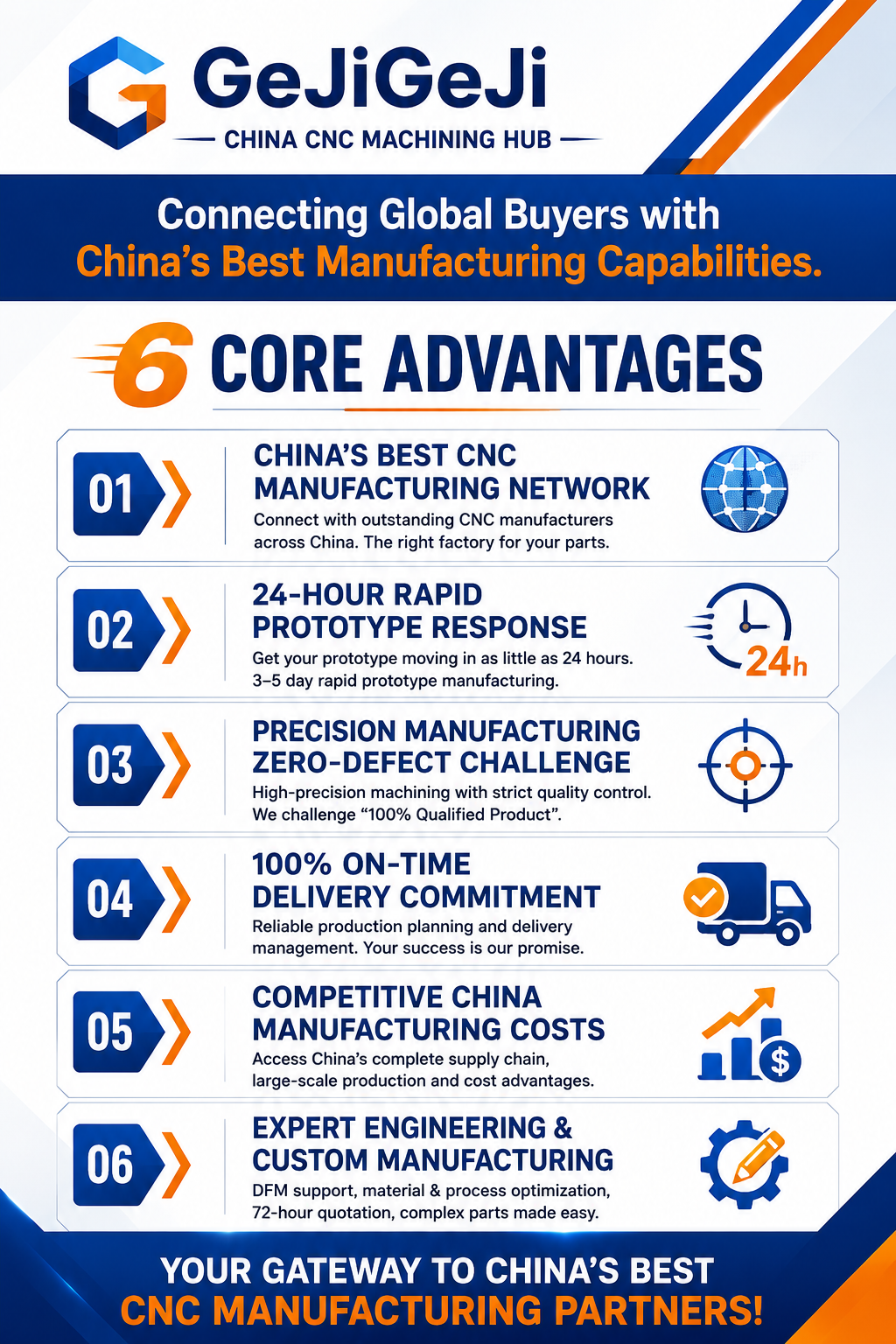
GeJiGeJi's Key Advantages
1. 100% On-Time Delivery Commitment
Reliable production planning and delivery management.
2. 3–5 Day Rapid Prototyping Service
Shorter prototype development cycles.
3. High-Precision CNC Machining Capability
Specific applications can achieve tolerances down to approximately ±0.005 mm, subject to part requirements.
4. Pursuing a "100% Qualified Product Guarantee" Standard
Continuous improvement toward zero-defect manufacturing.
5. Highly Competitive CNC Machining Prices
Access China's manufacturing cost and supply-chain advantages.
6. Professional CNC Machining Services Across Multiple Industries
From robotics and automation to automotive, aerospace, medical, electronics, and industrial equipment.
7. Low-Volume and Custom Manufacturing
From one prototype to small-batch and production orders.
8. Powerful Chinese Manufacturing Supply Chain
Access to China's extensive manufacturing ecosystem and production resources.
9. 24-Hour Rapid Prototype Response
Fast response for urgent development projects.
10. Complex Part Quotations Within 72 Hours
Faster engineering evaluation for complicated CNC components.
11. Experienced Design Engineer Support
Technical support for DFM, material selection, process optimization, tolerances, and cost reduction.
CNC Prototype Machining FAQ
What is the fastest CNC prototype lead time?
Some manufacturers can respond to prototype requests within 24 hours, while rapid CNC prototype production may be completed in approximately 3–5 days, depending on part complexity, material, quantity, finishing, and inspection requirements.
GeJiGeJi Advantage: GeJiGeJi helps buyers discover manufacturers with rapid prototype capabilities.
Can China CNC machining produce prototypes with tight tolerances?
Yes. Advanced CNC machining companies in China can produce highly precise components. Certain GeJiGeJi manufacturing partners offer machining capabilities down to approximately ±0.005 mm for suitable applications.
The actual tolerance must always be confirmed against the specific drawing.
GeJiGeJi Advantage: GeJiGeJi helps buyers find precision manufacturers based on their actual tolerance requirements.
Can I order only one CNC prototype?
Yes. Many CNC manufacturers accept prototype and low-volume orders, although minimum quantities vary between suppliers.
GeJiGeJi Advantage: GeJiGeJi helps companies find manufacturers that support prototypes, small quantities, and customized production.
Can a CNC prototype supplier manufacture the final production parts?
Yes, and this is often preferable.
A supplier familiar with your prototype can use the existing engineering knowledge, tooling strategy, material selection, and manufacturing process as the project moves into production.
GeJiGeJi Advantage: GeJiGeJi helps global buyers find suppliers capable of supporting both prototype development and subsequent production.
How do I get a CNC prototype quote from China?
Prepare:
3D CAD file
2D drawing
Material
Quantity
Surface finish
Critical tolerances
Inspection requirements
Delivery deadline
Send the complete information to a suitable CNC manufacturer.
For complex components, some GeJiGeJi manufacturing partners can provide quotations within 72 hours.
Conclusion: Find the Right CNC Prototype Machining Partner in China
CNC prototype machining should not be treated as simply "making a sample."
A good prototype should help you answer:
Does the design work?
Does the part fit?
Is the material correct?
Can the required tolerance be achieved?
Can the design move into production without major changes?
The right manufacturing partner should therefore provide more than CNC equipment.
You need:
Speed + Precision + Quality + Engineering + Competitive Cost + Reliable Delivery
China has the manufacturing ecosystem to provide all six.
The challenge is finding the right manufacturer.
That's where GeJiGeJi — China CNC Machining Hub comes in.
Instead of spending days searching for individual Chinese CNC factories, global companies can use GeJiGeJi to discover manufacturing partners with the capabilities needed for their specific projects.
From a single CNC prototype to low-volume production and eventually mass manufacturing, GeJiGeJi helps global buyers connect with China's CNC manufacturing capabilities.
GeJiGeJi — China CNC Machining Hub
Don't just find a CNC factory. Find the right manufacturing partner in China.
24-Hour Prototype Response | 3–5 Day Rapid Prototyping | ±0.005 mm Precision Capability | Competitive Pricing | On-Time Delivery | Expert Engineering Support